
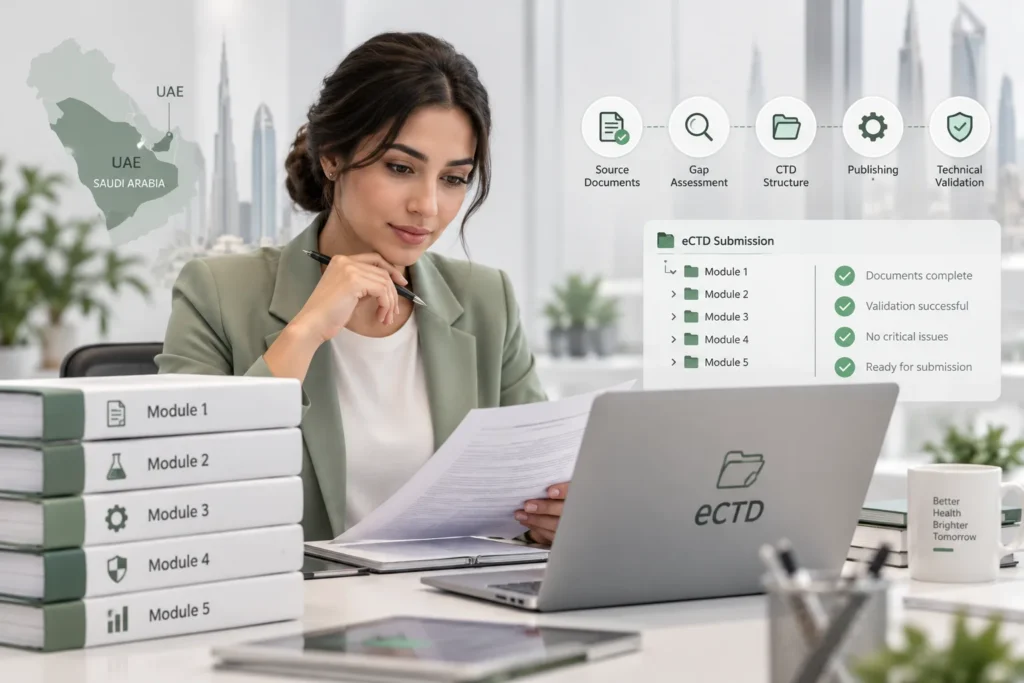

eCTD Dossier Services UAE & Saudi Arabia

Prepare a submission-ready pharmaceutical file with eCTD dossier services UAE and SFDA eCTD submission support. Wellness Traffic helps pharmaceutical manufacturers, marketing authorization teams and regulatory departments collect source documents, identify gaps, organize CTD Modules 1–5, prepare regional requirements, publish the electronic dossier and perform technical quality checks before authority submission.

What a Submission-Ready eCTD Dossier Requires

A strong regulatory dossier is more than a collection of PDFs. The scientific content, regional documents, module placement, file structure and submission lifecycle must work together. Our pharmaceutical dossier preparation process checks those elements before publishing begins.

eCTD Readiness Checks

  • Source Document Completeness

    Collect quality, non-clinical, clinical, administrative, labelling, pharmacovigilance and certificate documents required for the target <strong>eCTD submission</strong>.

  • Dossier Gap Assessment

    Map the available file against expected <strong>eCTD dossier requirements</strong> and identify missing, expired, inconsistent or market-specific documents before publishing.

  • CTD Module & Regional Structure

    Organize content into Modules 1–5 and separate global scientific content from <strong>UAE eCTD</strong> or <strong>Saudi Module 1</strong> requirements.

  • Publishing & Technical Validation

    Check document placement, readability, navigation, sequence logic and lifecycle readiness so the electronic submission is technically prepared for authority validation.

The eCTD Dossier Structure: Modules 1–5

A complete pharmaceutical eCTD dossier is structured so reviewers can move from regional administrative information to summaries, quality, non-clinical and clinical evidence. The exact content required depends on product type and authority.

Module 1 — Regional Information

Module 1 eCTD contains market-specific administrative information such as forms, product information, labelling, certificates, pharmacovigilance and other regional documents.

Module 2 — CTD Summaries

Module 2 contains the quality overall summary plus non-clinical and clinical overviews and summaries that guide reviewers through the supporting evidence.

Module 3 — Quality / CMC

Module 3 pharmaceutical dossier content covers drug substance and drug product quality, manufacturing, controls, specifications, validation and stability information.

Module 4 — Non-Clinical

Module 4 contains non-clinical study reports and supporting pharmacology, pharmacokinetic and toxicology data where applicable to the submission.

Module 5 — Clinical

Module 5 contains clinical study reports, bioavailability or bioequivalence evidence and other clinical documentation required for the product type.

Lifecycle, Responses & Sequences

eCTD lifecycle management keeps later responses, variations, updates and document replacements connected to the approved electronic submission history.

UAE vs Saudi eCTD: Why Module 1 Must Be Localized

The scientific CTD core may be reusable, but regional Module 1 requirements are market-specific. A dossier prepared for one authority should not simply be copied into another market without checking the local administrative, product-information and submission requirements.

UAE — EDE eCTD

For UAE pharmaceutical marketing authorization, the current federal authority is the Emirates Drug Establishment (EDE). The file must be prepared around the current EDE application route and its eCTD technical file requirements.

Saudi Arabia — SFDA eCTD

SFDA’s current human-drug data requirements use the eCTD structure and define Saudi regional information in Module 1 alongside Modules 2–5.

A Strong Dossier Can Still Fail Technical Validation

The authority must be able to locate, review and maintain the submission efficiently. A scientifically complete file can still face avoidable problems if documents are placed in the wrong module, regional requirements are missing, lifecycle operations are inconsistent, or the submission cannot be technically validated.


Wellness Traffic provides eCTD publishing services, regulatory dossier preparation UAE and SFDA dossier preparation support with attention to both regulatory content and electronic submission structure.

Submission Quality Is Part of Regulatory Quality

The goal is a validation-ready eCTD dossier that gives reviewers a clear path through the administrative, quality, non-clinical and clinical evidence—without promising an authority outcome that only EDE or SFDA can decide.

— Wellness Traffic Regulatory Team

How We Prepare an eCTD Dossier for Submission

Our eCTD dossier preparation process starts with the documents you already have and ends with a technically reviewed, authority-specific submission package. The exact workstream depends on the product and application type.

01.
Dossier Intake & Gap Assessment

We review the available regulatory, quality, non-clinical, clinical, labelling and administrative documents and map them against the target eCTD requirements.

Stage 01

02.
Document Remediation & Regional Requirements

We identify missing or inconsistent documents and organize the UAE or Saudi regional content, including the applicable Module 1 requirements.

Stage 02

03.
CTD Module Structuring

Source documents are placed into the appropriate CTD modules and sections so the scientific and administrative content follows a logical review path.

Stage 03

04.
eCTD Publishing & Technical QC

We prepare the electronic submission structure and review document placement, readability, links, sequence logic and other eCTD validation considerations.

Stage 04

05.
Submission, Responses & Lifecycle Support

We support the submission-ready package and help organize authority responses, replacement documents, variations or later eCTD lifecycle sequences where applicable.

Stage 05

eCTD Validation & Dossier Quality Control

A technically clean eCTD submission can reduce avoidable return cycles before scientific review. Our QC process checks both the electronic structure and the regulatory consistency of the documents being submitted.

Technical eCTD Validation

Regulatory Content QC

Common Reasons an eCTD File Needs Rework

Many technical delays are avoidable. These are common issues we check during eCTD validation and dossier quality review.

A globally prepared dossier may still be incomplete if the UAE or Saudi administrative and product-information requirements are missing.

Missing Regional Module 1 Documents DOSSIER RISK

Correct scientific content placed in the wrong location can make the file harder to validate, navigate and review.

Wrong Module or Section Placement DOSSIER RISK

Product name, strength, dosage form, manufacturer details, labelling and certificates should be consistent across the dossier.

Inconsistent Product Information DOSSIER RISK

Administrative documents and certificates should be checked for validity and market-specific acceptance before submission.

Expired or Incomplete Certificates DOSSIER RISK

Later sequences, replacements and responses must maintain a clear electronic history rather than creating conflicting document versions.

Lifecycle or Sequence Errors DOSSIER RISK

Dossier & eCTD Submission FAQs

Answers to high-intent questions about eCTD dossier services UAE, SFDA eCTD submission, Modules 1–5, validation and dossier preparation.

Need Your Existing Dossier Reviewed?

Share the target market, product type and available submission documents. We can help identify gaps in your regulatory dossier before publishing or authority submission.

An eCTD dossier is the electronic Common Technical Document format used to organize pharmaceutical regulatory information into a defined module structure for electronic submission and lifecycle management.

Yes. The Emirates Drug Establishment (EDE) states that documents for drug and biopharmaceutical marketing authorization are submitted according to the standard technical file eCTD requirements.

Yes. The Saudi Food and Drug Authority publishes current Data Requirements for Human Drugs Submission using the eCTD structure and Modules 1–5.

Module 1 contains regional administrative information. Module 2 contains summaries and overviews. Module 3 covers quality. Module 4 contains non-clinical study reports. Module 5 contains clinical study reports.

Module 1 is the regional section of the dossier. It can include application forms, product information, labelling, certificates, pharmacovigilance and other authority-specific administrative documents.

eCTD validation checks the technical structure and presentation of the electronic submission. A dossier can contain strong scientific data but still need correction if the structure, links, file placement or lifecycle information is not prepared correctly.

Yes. We can review existing source documents, perform a dossier gap assessment, map the content to the target module structure and prepare the file for publishing and technical quality control.

Yes. Wellness Traffic supports UAE eCTD dossier preparation and SFDA eCTD Saudi Arabia preparation, with attention to regional Module 1 differences and authority-specific submission requirements.

No. Final validation and scientific review are controlled by the relevant regulatory authority. Our role is to improve dossier readiness, reduce avoidable technical errors and support a clearer submission structure.

Stay Updated on eCTD & Drug Registration Requirements

Receive practical updates on eCTD submissions, EDE pharmaceutical registration, SFDA requirements, Module 1, dossier quality and regulatory market access.