Regulatory Expertise Across the Products We Register
Different products follow different rules. Wellness Traffic supports regulatory compliance UAE and Saudi regulatory compliance across pharmaceuticals, medical devices, cosmetics, supplements, food, veterinary products, herbal products, disinfectants, FMCG and in vitro diagnostics.
Our role is to identify the correct product category, authority, registration route, technical file, labelling requirements and post-market obligations before the wrong pathway creates delays. This page connects each industry to the right product registration, labelling and artwork, dossier, safety or licensing support.
Product Registration & Compliance by Industry
Each industry has its own classification logic, evidence standards and authority expectations. We tailor the regulatory pathway to the product rather than forcing every submission through one generic process.

Pharmaceuticals
Pharmaceutical registration UAE and Saudi support for innovator medicines, generics and other medicinal products, including eCTD dossier preparation, variations, renewals and pharmacovigilance obligations.

Medical Devices
Medical device registration UAE and Saudi pathways covering classification, manufacturer / applicant readiness, conformity evidence, marketing authorization, labelling and post-market obligations.

Cosmetics & Personal Care
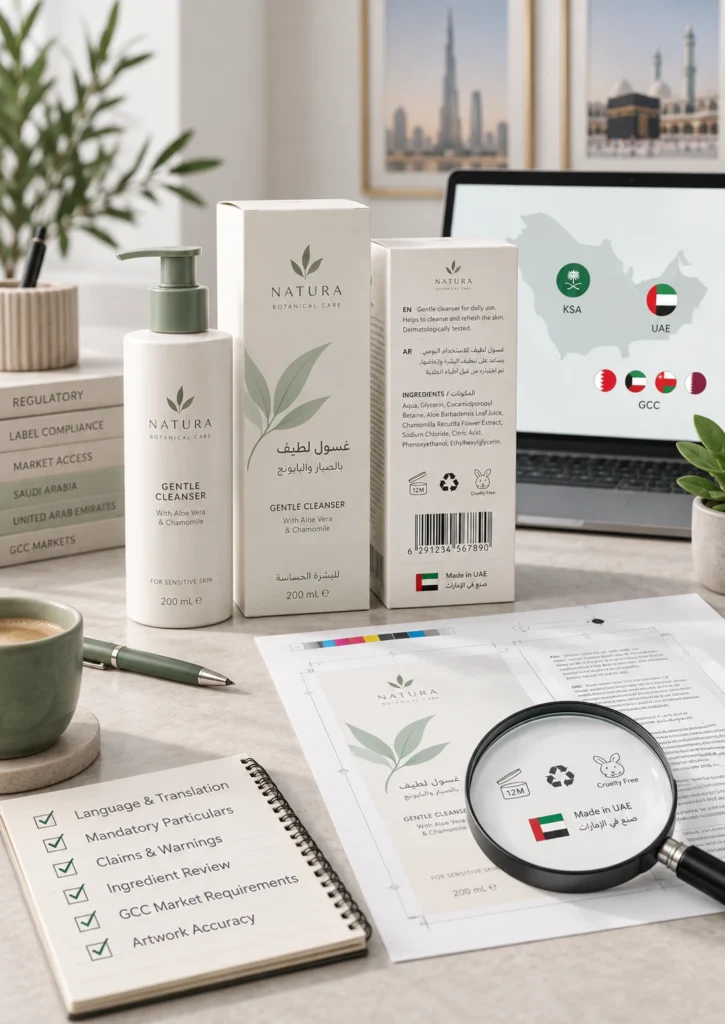
Cosmetic product registration Dubai and Saudi cosmetic compliance, including Dubai Municipality consumer-product routes, SFDA requirements, Arabic artwork, ingredients, claims and product-label readiness.

Supplements & Health Products
Health supplement registration UAE and Saudi support for consumer-health products, including classification, claims, formulation, supporting documents and compliant bilingual labelling.

Food & Beverage
Food product registration UAE and Saudi food registration support, with authority mapping, product data, ingredient and label review, import-readiness and food-market compliance according to the applicable route.

In Vitro Diagnostics (IVD)
IVD registration UAE and Saudi support for laboratory diagnostics, self-tests, point-of-care products and related diagnostic devices. Current UAE medical-device pathways should be mapped to EDE rather than legacy MOHAP terminology.
UAE vs Saudi Arabia: The Authority Changes With the Product
A strong GCC regulatory strategy starts with authority mapping. The UAE uses a mix of federal and emirate-level routes depending on product type, while Saudi Arabia centralizes major food, drug, cosmetic and medical-device regulation under SFDA. Product classification should be confirmed before the dossier or artwork is built.
UAE — EDE, Dubai Municipality & Other Relevant Routes
The Emirates Drug Establishment (EDE) is the current federal regulator for medical and pharmaceutical products, including medical devices and veterinary medicines. Dubai Municipality continues to regulate and register multiple consumer-product categories through its consumer-product services and Montaji environment.
- Pharmaceuticals, medical devices and many medical products — EDE
- Cosmetics, personal care, fragrances, health supplements, detergents and other consumer products — Dubai Municipality routes where applicable
- Food products — relevant federal / local food-authority and municipal routes depending on activity and emirate
- Classification should be confirmed before relying on legacy MOHAP or generic UAE terminology
Saudi Arabia — SFDA Product-Specific Pathways
The Saudi Food and Drug Authority (SFDA) regulates major product sectors including food, drugs, cosmetics and medical devices. The exact submission, establishment, labelling and post-market requirements still differ significantly between those sectors.
- Medicines and pharmaceutical products — SFDA drug requirements
- Medical devices and IVDs — SFDA medical-device requirements and marketing authorization
- Cosmetics and personal care — SFDA cosmetic notification / compliance requirements
- Food and supplements — applicable SFDA food / product requirements and labelling framework
Additional Regulated Industries We Support
Not every regulated product fits neatly into the six largest categories. We also support sectors where classification, intended use, claims, ingredients or product composition can change the regulatory route.
Veterinary & Traditional Health
- Veterinary product registration UAE and Saudi route assessment
- Veterinary medicines and related medical-product classification
- Herbal product registration UAE and Saudi classification support
- Traditional / herbal products where claims and composition determine the authority route
- Label, claim and ingredient review before submission
- Post-registration changes and renewal planning where applicable
Disinfectants, Detergents & FMCG
- Disinfectant registration Dubai and Saudi route assessment
- Detergent, cleaning-agent and household chemical compliance
- Safety data sheet / composition and label review where relevant
- FMCG personal-care, home-care and general consumer-product registration
- Multi-SKU and portfolio-level artwork / product-data coordination
- UAE / Saudi market-specific claims, artwork and importer-readiness checks
The Same Ingredient or Device Technology Can Follow a Different Route
Regulatory category is driven by intended use, composition, claims, dosage form, mechanism of action, presentation and product design. A product described commercially as a supplement, cosmetic, wellness product or device may still require a different authority route after formal classification.
For the UAE, EDE’s current medical product classification service determines the regulatory category and whether marketing authorization is required. For consumer products, Dubai Municipality category rules and technical guidance can determine the municipal registration path.
Classify First. Build the Submission Second.
Correct classification protects the dossier, artwork, testing plan and launch timeline. It also reduces the risk of optimizing the wrong documents for the wrong authority.
— Wellness Traffic Regulatory Team
How We Build the Right Pathway for Each Product Industry
Our process stays consistent at a strategic level, but the authority, evidence, label and post-market requirements change with the industry.
01.
Classify the Product
We review intended use, formulation, claims, product design and available certificates to identify the likely regulatory classification.
Stage 01
- Classification
02.
Map the Authority & Market Route
We determine the likely UAE and/or Saudi authority, applicant structure and the registration, notification or marketing-authorization route.
Stage 02
- Authority Map
03.
Build the Industry-Specific File
We organize the technical, quality, safety, ingredient, conformity, dossier or product-information evidence required for that category.
Stage 03
- Technical File
04.
Align Artwork, Claims & Supporting Data
We check the labelling and artwork against the product category so the commercial pack supports rather than contradicts the submission.
Stage 04
- Artwork & Claims
05.
Manage Submission & Post-Market Needs
We support the authority process and identify renewals, pharmacovigilance, variations, import, licensing or other post-registration obligations relevant to the industry.
Stage 05
- Lifecycle
What Changes When the Product Category Changes?
The registration route can change dramatically even when two products look similar commercially. These are the core areas we re-check for every new industry and product category.
Category-Specific Regulatory Checks
-
Authority & Applicant Structure
Confirm which authority regulates the product and whether the applicant needs a local establishment, licensed warehouse, marketing office, importer, distributor or another market-specific setup.
-
Evidence & Technical Documentation
Determine whether the category needs a full dossier, conformity evidence, ingredients / composition, testing, clinical or safety data, Free Sale evidence, technical specifications or other supporting documents.
-
Labelling, Claims & Language
Check product claims, Arabic / bilingual content, warnings, ingredients, directions, model or strength information and other <strong>industry-specific label requirements</strong>.
-
Post-Market & Lifecycle Obligations
Identify renewals, variations, pharmacovigilance, vigilance, recalls, safety reporting, import controls, quality licences or other continuing obligations after approval.
Why Products Get Put on the Wrong Regulatory Path
Many avoidable delays begin before submission—with an incorrect category, outdated authority assumption or documentation package built for a different product type.
A brand may call a product cosmetic, supplement or wellness technology while the authority classifies it differently based on use, composition, claims or mechanism.
Commercial Category Is Treated as Regulatory Classification
REGULATORY RISK
Older UAE guidance may still mention MOHAP for activities now handled through EDE. Current authority terminology should be checked before submission planning.
Legacy Authority Information Is Still Being Used
REGULATORY RISK
UAE and Saudi authorities can require different applicants, regional documents, labels, portals and post-market activities even for the same product.
One Country's File Is Copied Into Another
REGULATORY RISK
Claims, ingredients, warnings and product presentation can affect classification. Printing early can create expensive artwork rework.
Artwork Is Finalized Before Classification
REGULATORY RISK
Pharmacovigilance, vigilance, quality licences, renewals, variations and importer obligations may need to be designed before the product is commercially launched.
Post-Market Obligations Are Ignored Until Approval
REGULATORY RISK
UAE & Saudi Product Industry FAQs
Direct answers about pharmaceutical registration UAE, medical devices, cosmetics, supplements, food, veterinary products, FMCG and IVD registration UAE and Saudi Arabia.
Not Sure Which Industry or Authority Your Product Falls Under?
Send the product name, intended use, formulation / composition, claims, target market and available certificates. We can help identify the likely category and next regulatory route.
Wellness Traffic supports pharmaceuticals, medical devices, cosmetics and personal care, health supplements, veterinary products, herbal and traditional products, food and beverage, disinfectants and detergents, FMCG and in vitro diagnostics (IVD) across UAE and Saudi regulatory pathways.
The Emirates Drug Establishment (EDE) is the current federal authority responsible for regulating medical and pharmaceutical products in the UAE, including pharmaceuticals, medical devices and veterinary medications.
Dubai Municipality operates consumer-product registration services through the Montaji environment. Its published consumer-product categories include cosmetics and personal care, health supplements, detergents, biocides, fragrances and food-contact materials.
The Saudi Food and Drug Authority (SFDA) regulates major sectors including food, medicines, cosmetics and medical devices. Each sector has its own registration, establishment, labelling and post-market requirements.
IVDs are part of the medical-device regulatory landscape. SFDA explicitly includes In Vitro Diagnostics (IVDs) within its medical-device objectives. In the UAE, IVD regulatory planning should use the current EDE medical-device framework and confirm the exact classification for the product.
No. The route depends on the product formulation, claims, presentation and regulatory classification. Some products may sit within consumer-product frameworks while others can require a different medical-product classification.
Yes. Claims and intended use can affect regulatory classification. A cosmetic or personal-care product making therapeutic or medicinal-type claims may need further classification review before the registration route is chosen.
No. The markets can share GCC concepts and standards, but authority, applicant, dossier, artwork, language, portal and post-market requirements can differ. The same product should be mapped separately for each country.
Yes. We can map a mixed portfolio by category and authority, then coordinate classification, registration, artwork, dossier, quality, market access and post-market needs across multiple SKUs.
No. Final classification and approval decisions belong to the relevant authority. Our role is to improve route selection and submission readiness and reduce avoidable regulatory gaps.
Stay Updated Across UAE & Saudi Product Categories
Receive practical updates on product classification UAE, EDE, Dubai Municipality, SFDA, medical devices, cosmetics, supplements, food, pharmaceuticals and other regulated industries.